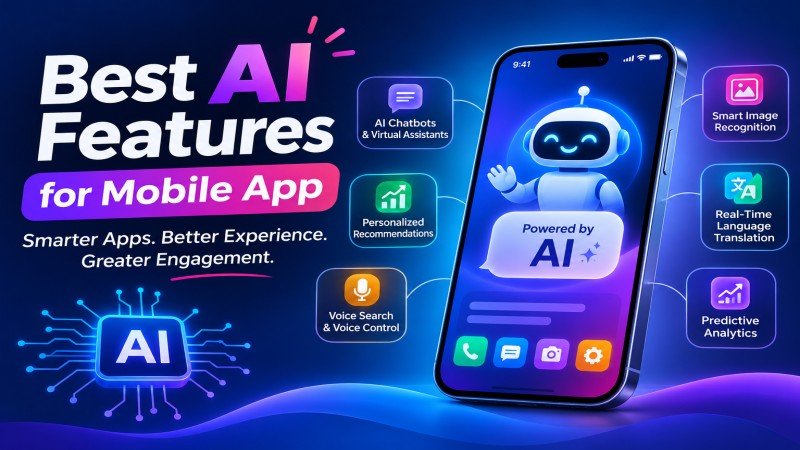
Mobile applications have become an essential part of modern business operations. From online shopping and customer support to financial services and healthcare, businesses use mobile apps to connect with customers, improve accessibility, and deliver better experiences. However, as customer expectations continue to evolve, traditional mobile applications may not be enough to maintain a competitive advantage.
Artificial Intelligence (AI) is transforming mobile app development by making applications smarter, faster, and more personalised. AI-powered features can analyse user behaviour, automate repetitive tasks, improve security, and provide intelligent recommendations. Businesses looking to develop a future-ready application should consider integrating AI capabilities that align with their goals and customer needs.
In this blog, we explore the best AI features to include in a business mobile app and how they can improve user experience, operational efficiency, and business growth.
Why Should Businesses Integrate AI into Mobile Apps?
AI enables mobile applications to process information, identify patterns, and provide intelligent responses based on available data. Instead of relying entirely on fixed instructions, AI-powered apps can adapt to user preferences and changing requirements.
Some important benefits include:
Improved User Experience: AI helps deliver personalised content, relevant recommendations, and faster customer assistance.
Business Automation: Repetitive activities can be automated, reducing manual effort and operational delays.
Better Decision-Making: AI analytics can identify customer behaviour patterns and provide useful business insights.
Enhanced Security: Intelligent systems can help detect suspicious activities and potential fraud.
Higher Customer Engagement: Personalised notifications and interactive features encourage users to engage with the application.
For businesses investing in mobile app development, AI integration can create opportunities to deliver more efficient and competitive digital services.
8 Best AI Features to Include in Your Business Mobile App
1. AI-Powered Chatbots and Virtual Assistants
AI-powered chatbots are among the most useful features for business applications. They can respond to frequently asked questions, provide product information, guide users through services, and assist with basic customer support requests.
Unlike traditional rule-based chatbots, modern AI assistants can understand natural language and interpret customer queries more effectively.
For example, an eCommerce application can use an AI chatbot to help customers find products, understand delivery policies, or track orders. This improves customer convenience while reducing the workload on support teams.
2. Personalised Recommendations
Personalisation plays an important role in customer satisfaction and retention. AI recommendation engines analyse user preferences, browsing history, previous purchases, and interactions to suggest relevant products or services.
For example, a shopping application can recommend products based on a customer's previous purchases, while a learning application can suggest courses according to individual interests.
These recommendations make applications more relevant and can support improved conversion rates and customer engagement.
3. Predictive Analytics
Predictive analytics uses historical information and statistical or machine learning models to estimate future trends and behaviours.
Businesses can integrate predictive analytics into their mobile applications to understand customer demand, identify purchasing patterns, forecast inventory requirements, and anticipate potential customer churn.
For example, a retail business can use predictive insights to plan stock requirements before periods of high demand. This supports better resource planning and informed decision-making.
4. Voice Search and Voice Commands
Voice-enabled functionality makes mobile applications more accessible and convenient. Users can search for products, navigate application features, or perform specific actions using spoken commands.
AI-powered speech recognition converts spoken language into text or instructions that the application can process.
This feature can be particularly useful for travel applications, shopping platforms, productivity tools, and hands-free business services.
5. AI-Based Image Recognition
Image recognition allows mobile applications to identify and analyse objects, products, documents, and visual information.
For instance, an eCommerce application can allow users to upload a product image and find visually similar items. Similarly, a document management application can use AI-powered image processing to extract information from scanned documents.
This feature can simplify searches, reduce manual work, and improve the overall functionality of business applications.
6. Intelligent Fraud Detection and Security
Security is a major concern for applications that handle financial transactions, personal information, and confidential business data.
AI-based fraud detection systems can analyse transaction patterns, login behaviour, device information, and unusual activities to identify potential threats.
For example, if an account suddenly displays unusual transaction behaviour, the system can flag the activity for further verification.
AI should complement, rather than replace, essential security measures such as encryption, secure authentication, access controls, and regular security testing.
7. Sentiment Analysis and Customer Feedback
Understanding customer opinions helps businesses improve their products and services. AI-powered sentiment analysis can examine reviews, feedback messages, and customer interactions to identify positive, negative, or neutral opinions.
A business mobile app can use this feature to organise customer feedback, identify recurring complaints, and highlight areas requiring improvement.
These insights help businesses understand customer expectations and make better service-related decisions.
8. AI-Powered Notifications
Traditional push notifications often deliver the same messages to every user, which may reduce engagement over time.
AI-powered notification systems can analyse user activity, preferences, and engagement patterns to determine which messages are relevant and when they should be delivered.
For example, a fitness application may send reminders based on a user's activity schedule, while a shopping application may notify customers about products related to their interests.
Relevant notifications can improve engagement without overwhelming users with unnecessary messages.
Important Factors to Consider Before Adding AI Features
Although AI offers several advantages, businesses should plan their integration carefully. Adding too many features without a clear purpose can increase development costs and make an application unnecessarily complicated.
Consider the following factors before implementation:
Business Objectives: Select AI features that address specific business challenges.
Customer Requirements: Understand what users expect from the application.
Data Quality: Ensure that the data used for AI systems is accurate, relevant, and collected appropriately.
Privacy and Security: Follow applicable data protection requirements and implement suitable safeguards.
Development Budget: Evaluate infrastructure, integration, maintenance, and ongoing AI service costs.
Scalability: Choose an architecture that can support future business growth and increasing user demand.
Working with an experienced development team can help businesses select appropriate technologies and integrate AI features effectively.
How Kriti Digital Solutions Can Help
Successful AI integration requires a combination of technical expertise, business understanding, and effective application design. Kriti Digital Solutions can support businesses in planning and developing mobile applications that align with their operational requirements and customer expectations.
From understanding project objectives to selecting suitable technologies and implementing application features, a structured development approach helps create reliable and scalable digital solutions.
Businesses should focus on building applications that solve real problems rather than integrating AI simply because it is a growing technology trend.
Conclusion
AI is changing the way businesses develop and use mobile applications. Features such as intelligent chatbots, personalized recommendations, predictive analytics, voice search, image recognition, and fraud detection can make business apps more efficient and user-friendly.
Choosing the right features depends on the application's purpose, target audience, available data, and long-term business objectives. With thoughtful planning and professional mobile app development, businesses can use AI to improve customer experiences, automate processes, and strengthen their digital presence.
Integrating AI into a business mobile app is not just about adopting new technology; it is about creating smarter digital experiences that deliver measurable value.