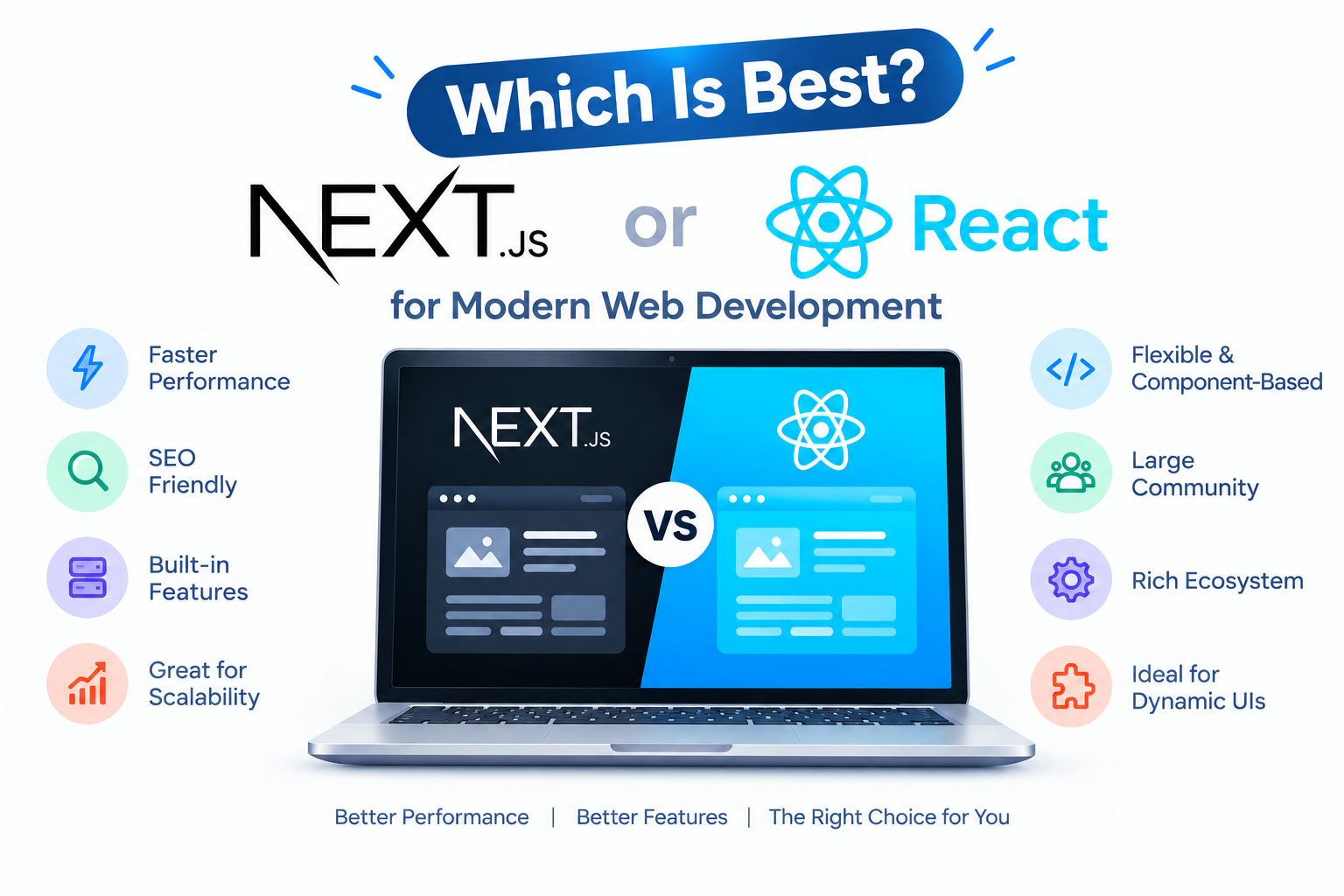
Modern businesses need websites and web applications that are fast, responsive, scalable, secure, and easy to maintain. As user expectations continue to rise, choosing the right frontend technology has become an important part of the development process.
Two popular technologies frequently considered for modern web development are React and Next.js. Both are part of the JavaScript ecosystem and are widely used for building interactive digital experiences. However, they serve somewhat different purposes.
Understanding the differences between Next.js vs React can help businesses and development teams select a technology that matches their project requirements.
What Is React?
React is an open-source JavaScript library for building user interfaces. It was developed by Meta and is based on a component-driven approach.
Developers can create reusable components and combine them to build complex user interfaces. React is particularly popular for applications where users interact with the interface frequently.
Common React use cases include:
Single-page applications
SaaS applications
Dashboards
Interactive platforms
Customer portals
Social applications
eCommerce interfaces
One of React's major advantages is its extensive ecosystem. Developers can select additional libraries and tools for routing, data management, testing, and other application requirements.
What Is Next.js?
Next.js is a React-based web framework that provides additional functionality for building modern web applications.
While React primarily focuses on the user interface layer, Next.js provides features for application development, including routing, rendering strategies, optimization, and other full-stack capabilities.
Next.js web development can support different rendering approaches depending on the application's requirements.
Some of its commonly used capabilities include:
File-based routing
Server-side rendering
Static generation
Dynamic rendering
Image optimization
Code splitting
API and server functionality
Flexible application architecture
This makes Next.js useful for websites and applications that need more functionality than a basic React setup provides.
Next.js vs React: Key Differences
The primary distinction is that React is a UI library, while Next.js is a framework built around React.
Performance
Performance is an important consideration in modern web development.
React applications can be highly performant when they are properly designed and optimized. Developers can use techniques such as lazy loading, code splitting, caching, and efficient component rendering.
Next.js provides additional tools that can simplify performance optimization. Depending on the application, developers can choose between server-side rendering, static generation, and client-side rendering.
This flexibility can be particularly useful when an application contains both static and dynamic content.
However, using Next.js does not automatically make every application faster. Performance still depends on architecture, code quality, database performance, hosting infrastructure, image optimization, and other factors.
SEO Considerations
Search engine optimization can be particularly important for business websites, blogs, marketplaces, and eCommerce platforms.
Traditional client-rendered applications may require additional considerations when implementing SEO strategies. React can certainly be used to create SEO-friendly applications, but developers may need to configure the architecture appropriately.
Next.js provides rendering options that can make it convenient to build websites where search engine accessibility and fast content delivery are important.
For example, websites containing:
Product pages
Service pages
Blog articles
Landing pages
News content
Documentation
may benefit from an architecture that supports efficient server or static rendering.
Routing
React does not provide a complete routing system as part of the core library. Developers generally use an additional routing solution depending on the application's requirements.
Next.js provides routing as part of its framework architecture.
This can simplify application organization because developers can structure routes according to the framework's conventions.
For larger projects, built-in routing can reduce the amount of configuration required during development.
Development Experience
React gives developers considerable freedom when designing the application's architecture. Teams can choose libraries and tools according to their preferences.
This flexibility is useful for experienced teams that want greater control over their technology stack.
Next.js provides more conventions and built-in capabilities. This can help teams establish a consistent project structure and reduce the need to make separate technology decisions for common requirements.
The choice therefore depends partly on whether a team prefers a highly flexible library-based approach or a more structured framework.
Scalability
Both React and Next.js can be used for scalable applications.
React's component-based architecture makes it possible to organize large interfaces into reusable components. However, larger applications typically require additional decisions around routing, state management, data fetching, and application architecture.
Next.js provides a broader application framework, which can simplify some of these architectural decisions.
For businesses planning to expand a website into a larger platform, the choice should be based on expected traffic, functionality, development resources, hosting requirements, and long-term maintenance.
When Should You Choose React?
React may be suitable when:
You primarily need an interactive user interface.
The application is heavily client-side.
Your development team already has strong React expertise.
You want maximum flexibility over supporting libraries.
You are building an internal dashboard or highly interactive application.
For organizations that already have an established React ecosystem, continuing with React may also reduce development complexity.
When Should You Choose Next.js?
Next.js may be suitable when:
SEO is an important requirement.
The project contains content-heavy pages.
Fast initial page delivery is important.
Multiple rendering strategies are needed.
You want built-in routing.
You are developing a full-stack web application.
You want a structured React-based framework.
Next.js can be particularly useful for business websites, eCommerce platforms, SaaS products, marketplaces, and content-driven applications.
Next.js vs React: Which One Should You Choose?
There is no universal answer to which technology is better. The appropriate choice depends on the project's requirements.
If the primary requirement is a flexible UI library and the development team wants to choose its own supporting technologies, React can be an appropriate option.
If the project requires a more comprehensive React-based framework with routing, multiple rendering approaches, and built-in optimization features, Next.js may be a better fit for the architecture.
It is also important to understand that choosing Next.js does not mean abandoning React. Next.js uses React, so developers who are familiar with React can transition to Next.js while continuing to use React concepts like components, props, and state.
How Kriti Digital Solutions Can Help
Selecting the right technology is only one part of successful React web development or Next.js development. Application architecture, UI/UX design, performance optimization, security, API integration, testing, and maintenance also play important roles.
Kriti Digital Solutions can help businesses plan and develop modern web applications according to their specific business objectives. Whether a project requires React or Next.js, we can tailor the development approach around factors such as scalability, performance, functionality, and user experience.
Conclusion
The Next.js vs React discussion is less about choosing a universal winner and more about selecting the right technology for a specific project.
React offers a flexible foundation for creating interactive user interfaces, while Next.js extends React with a broader framework and additional capabilities for modern web applications.
For businesses planning a new digital product, the best approach is to evaluate the application's SEO requirements, performance goals, complexity, scalability, development resources, and long-term maintenance needs before making a technology decision.
With the right architecture and experienced developers, both Next.js web development and React web development can be used to create modern, scalable, and high-quality digital experiences.