In today’s digital world, users want websites and apps to be fast, responsive, and compatible with all devices. A slow or poorly optimised interface can lead to higher bounce rates, lower engagement, and ultimately hurt conversions. This makes the choice of the right frontend framework critical for businesses investing in frontend development.
Frontend frameworks offer developers reusable components, development practices, and tools to build modern web applications. But there’s no one framework that’s perfect for every project Things like the complexity of the application, scaling requirements, rendering requirements, development resources and performance goals all come into play.
Knowing the benefits of the popular frameworks can help businesses looking for reliable frontend development services find a proper technology stack. In this article, we compare the top frontend technologies and discuss which are suitable for high-performance web design.
What is Front End Development?
The front end development is the part of a website or app that a user sees and interacts with. This includes design, navigation, buttons, forms, animations, content display and overall user experience.
Typical working zones for frontend developers are:
HTML Layout
CSS for layout and styling.
JavaScript for interactive
Scalable application development frameworks and libraries
Interface connection to the back end system API.
Today’s front-end developer is not just making things pretty. Performance, accessibility, responsiveness, security, maintainability and scalability are all important and carry equal weight.
Why Is The Framework Relevant To Performance?
It can impact the rendering speed of the application, the way the states are handled, the way resources are fetched, and the way the UI is updated.
Regarding high-performance use cases, businesses should consider the following:
Page load speed on first visit
Rendering performance
Bundle size
Code splitting and lazy loading
Server-side rendering features
Cache & Optimisation Settings
The developer's ecosystem.
Maintainability (long term)
Scalability .
But the framework itself is only part of performance. No matter which framework you choose, slow application performance can be caused by poor image optimisation, inefficient JavaScript, third-party script overload, slow APIs and bad hosting.
Top Frontend Frameworks for High-Performance Apps
1. React
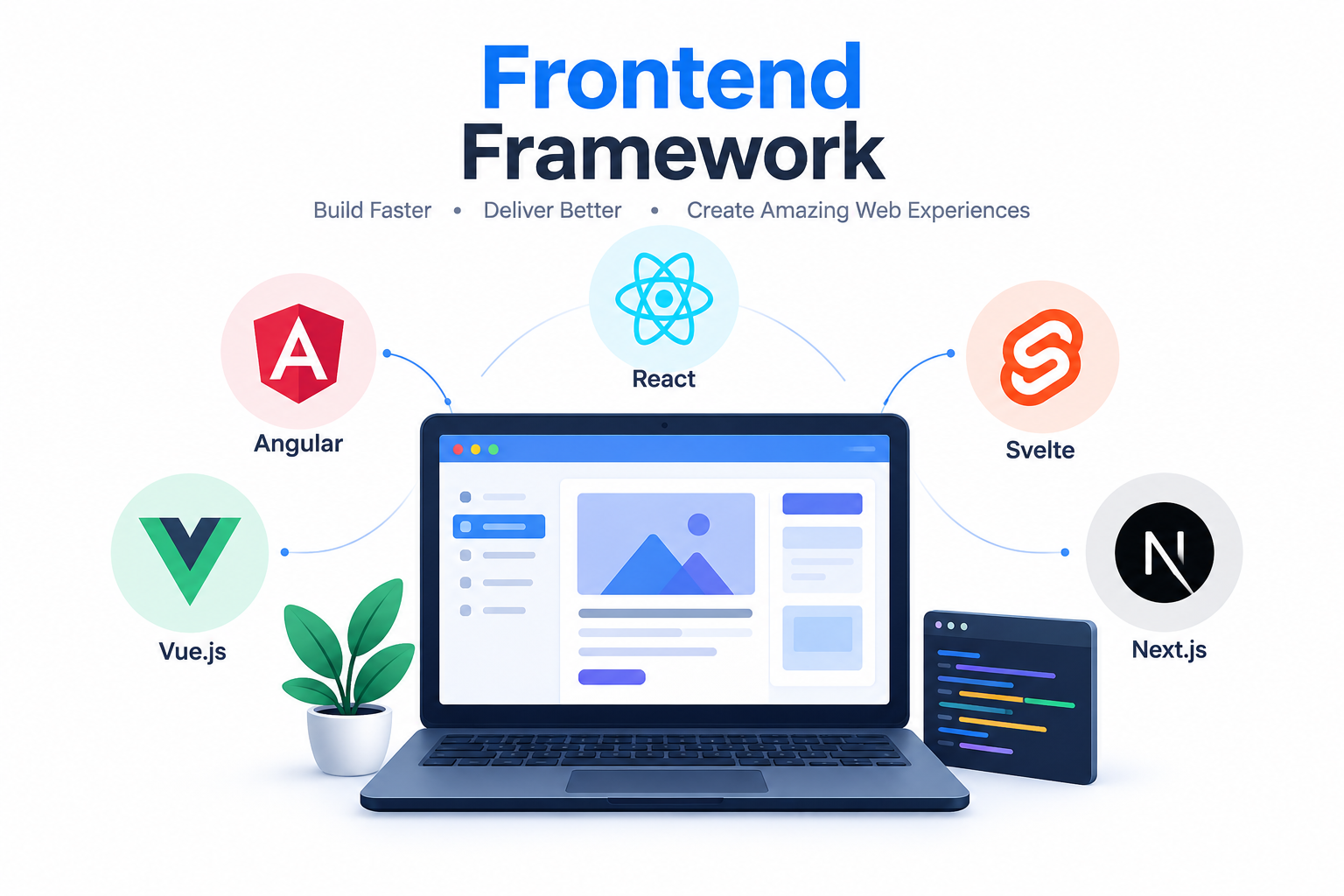
React is one of today’s most popular technologies for front-end developers. React is an open-source component-based front-end library developed by Facebook, which enables developers to build reusable UI components.
React is a JavaScript library, not a full-fledged framework. Still, React is often used with frameworks such as Next.js for creating complex web applications.
Performance benefits:
Component-based architectures
Fast UI
Code splitting
Lazy loading#
Large ecosystem
Next.js and other frameworks . Use Modern Rendering Techniques
React is a good choice for dashboards, SaaS, eCommerce applications, social applications, and complex interactive applications.
2. Next JS
Next.js is a framework on top of React for building modern web applications. It contains features that help developers optimise rendering, routing, data handling, and application performance.
Another big plus is its flexibility in rendering. For specific use cases, developers are able to choose among different methods such as server-side rendering, static generation and client-side rendering.
Next.js is a great option for organisations that need:
Fast-loading websites
SEO optimised pages
Interactive web applications
Platforms rich in content.
Webshops
Scalable SaaS apps
Next.js is a good choice for high-performance web design organisations that want flexibility in rendering and user experience.
3. Vue JS
Vue.js is a progressive JavaScript framework that has an approachable syntax and flexible architecture. It's useful for improving individual parts of a web page or for building entire single-page applications.
Vue provides:
Reactive data binding
Component-based development, fast rendering
Building Flexibility
Learning curve is easy
Vue is a great choice for businesses who want modern app features but don’t want the complexity.
4. Angular
Angular is a full-fledged framework backed by Google. Instead of lightweight libraries, Angular offers a wealth of features within its ecosystem that are indispensable for enterprise application development.
It has the means to
Forms for Routing
Dependency-Injection
State management patterns.
Test
Architecture of applications
It’s a good choice for large enterprise applications that require consistency, structured development, and long-term maintainability. That also means a steeper learning curve than some alternatives, due to its wider built-in feature set.
React vs Vue vs Angular vs Nextjs
There is no universal winner because different applications have different requirements.
If you want high performance, developers need to look at the specific architecture of the application, not just pick a technology because it is popular.
How to Build a High-Performance Frontend?
Selecting the right framework is only the beginning. A complete performance strategy must consider the entire front-end architecture.
JavaScript optimisation
Large JavaScript bundles can increase load times. Developers are able to use methods such as tree shaking, code splitting and lazy loading to only deliver the resources that are necessary at any given time.
Image Optimisation
Webpage resources often have many pictures. But modern formats, responsive images, correct dimensions, compression and lazy loading can help reduce unnecessary data transfer.
Use caching. Browser and server caching helps to reduce the number of repeated requests for resources and improves the experience for returning visitors.
Don’t Create Unnecessary Dependencies
Having too many third-party libraries can bloat your bundle sizes and add unnecessary processing. Developers should carefully consider their dependencies.
Core Web Vitals Emphasis
Also, performance should be measured by real-user experience metrics . Core Web Vitals are good indicators of loading performance, responsiveness, and visual stability.
Responsive Design
An app with high performance should always offer a unified experience on smartphones, tablets, laptops and desktops. Responsive layouts and serving the right resources for the right device can improve usability and performance.
Selecting the appropriate framework for your business
“Before choosing a frontend technology, businesses should ask themselves a few questions.
What kind of app are you building?
A marketing site has very different requirements to a complex SaaS platform or enterprise dashboard.
How Important Is SEO?
Sites that are content driven might benefit from rendering approaches that allow pages to be made available to users and search engines quickly.
How complicated is the process?
Larger applications may need more rigid architectural structure and more comprehensive tooling.
How big should it be?
“A framework should permit future growth without unnecessary technical constraints.
What are the skills for development?
Also consider the availability of experienced developers and long term maintenance resources.
Importance of Professional Front-End Development Services
Choosing a framework without looking at the whole technical architecture can cause performance problems later on. Professional frontend development services can help companies understand their requirements, select the right technologies, develop reusable components, improve performance and support applications as they grow.
A good development team can also connect frontend applications to APIs, cloud infrastructure, analytics platforms, authentication systems, payment gateways and other business technologies.
Summary
So which is the best front-end framework for high-performance apps? It is contingent upon what the goals and technical requirements of the app are. React is versatile and has a giant ecosystem. Next.js has strong rendering and optimisation capabilities. Vue is easy and flexible. Angular has a full structure for enterprise applications.
In many projects today, it is not so much the name of the framework that matters, but rather the combination of a suitable framework, an efficient architecture, optimised assets, responsive design and continuous performance monitoring.
Kriti Digital Solutions offers tailored frontend development services that assist businesses in building fast, scalable, and user-friendly applications. With the right technology strategy, you can create digital experiences that are scalable, maintainable and responsive.