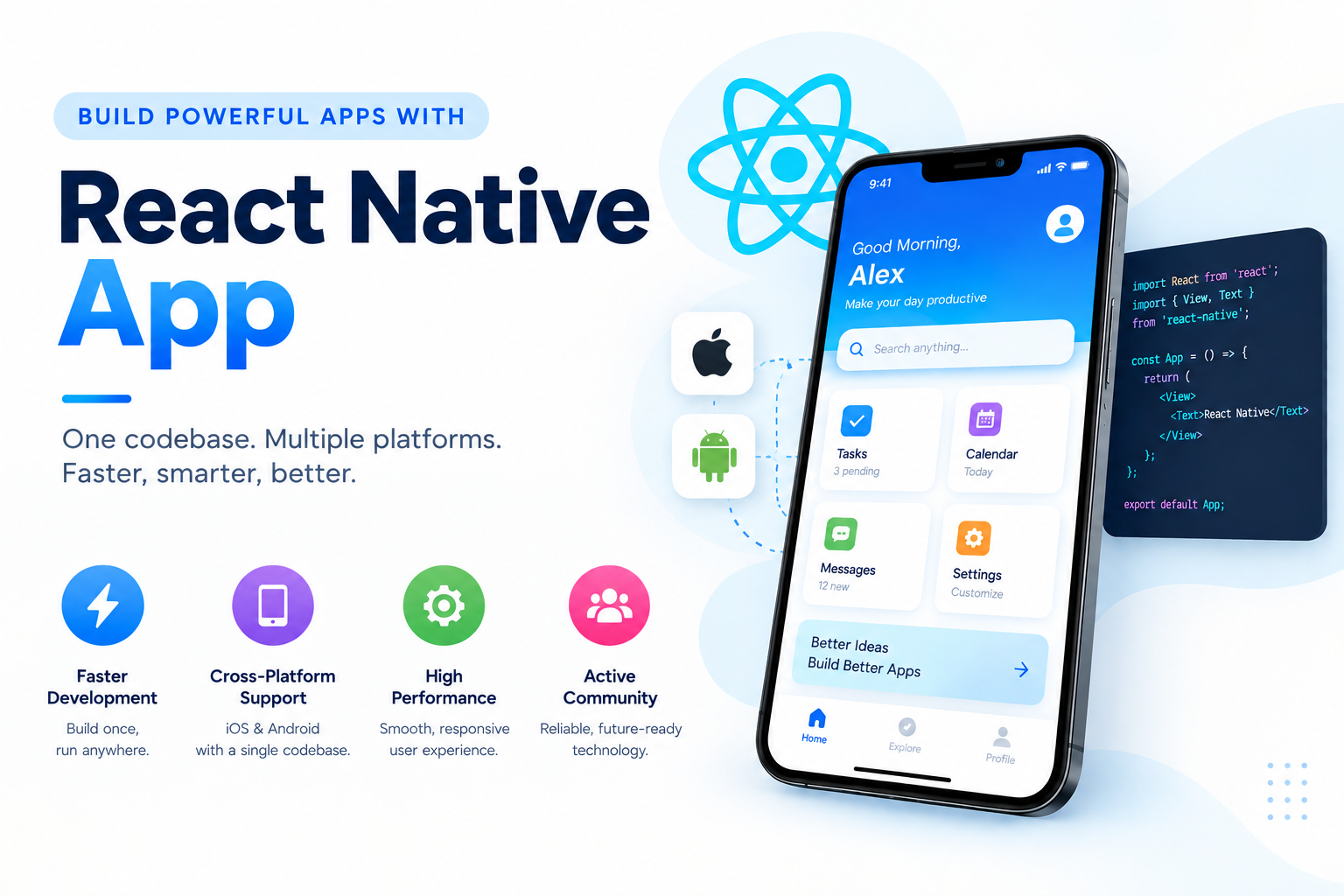
For startups, developing a mobile application is often about finding the right balance between quality, development cost, speed, scalability, and user experience. Building separate native applications for Android and iOS can require two development teams and separate codebases. This is one reason why React Native has become a popular technology for startups looking to develop mobile applications efficiently.
However, choosing the right React Native app developers for startups is just as important as choosing the technology itself. A capable development partner should understand startup requirements, MVP development, UI/UX, backend integration, testing, security, and long-term scalability.
What Is React Native App Development?
React Native is an open-source framework used to build mobile applications using JavaScript and React. It allows developers to create applications for platforms such as Android and iOS while sharing a significant portion of the codebase.
For startups, this approach can simplify development and maintenance. Instead of maintaining completely separate applications from the beginning, businesses can use a shared development approach where appropriate.
React Native is particularly useful for applications such as:
E-commerce platforms
Social networking applications
On-demand service apps
Business applications
Education platforms
Healthcare applications
Fintech interfaces
Booking and marketplace apps
The suitability of React Native ultimately depends on the application's technical requirements.
Why Should Startups Choose React Native?
Startups generally need to validate their product idea before investing heavily in development. React Native can support this approach by allowing businesses to develop applications for multiple platforms while sharing code.
1. Faster Development
Code sharing can reduce duplication between Android and iOS development. Developers can therefore spend more time improving product functionality instead of maintaining completely separate implementations for every feature.
This can be particularly useful when developing a minimum viable product (MVP).
2. Cost Efficiency
Using a shared codebase can potentially reduce development and maintenance costs compared with creating two entirely separate native applications. However, the actual cost depends on the complexity of the application, integrations, design, backend infrastructure, and development team.
3. Cross-Platform Development
One of React Native's primary advantages is its ability to support both Android and iOS development. This allows startups to reach users across multiple platforms without necessarily maintaining two independent development projects.
4. Reusable Components
React Native's component-based architecture makes it possible for developers to create reusable UI and functional components. This can help maintain consistency throughout an application and make future development easier.
5. Large Development Ecosystem
React Native has a broad ecosystem of libraries, tools, documentation, and developer resources. Startups can benefit from this ecosystem when integrating common application features such as authentication, navigation, analytics, notifications, and APIs.
What Makes the Best React Native App Developers for Startups?
The "best" development company is not necessarily the largest or most expensive one. Startups should evaluate potential development partners according to their specific project requirements.
Here are some important qualities to look for.
Strong React Native Expertise
A professional development team should understand React Native architecture, JavaScript or TypeScript, API integration, state management, navigation, performance optimization, and native Android and iOS integrations.
Developers should also know when React Native is appropriate and when native development may be better suited to a particular feature.
Experience With Startup Projects
Startup development is different from building software for an established enterprise. Startups often operate with limited budgets, evolving requirements, and aggressive timelines.
Experienced React Native app developers for startups should therefore understand MVP development and help prioritize features that are important for the initial launch.
UI/UX Design Capabilities
An application needs more than functional code. A confusing interface can negatively affect user adoption.
A strong development partner should understand:
Mobile-first design
User journeys
Navigation
Accessibility
Responsive layouts
Design systems
Platform-specific conventions
Good UI/UX should make the application easy to understand and use.
Backend and API Development
A mobile application rarely operates independently. It usually connects to databases, APIs, authentication systems, payment gateways, cloud services, analytics platforms, or third-party services.
Therefore, startups should consider developers who can work with both the mobile frontend and the supporting backend infrastructure.
Security and Testing
Security should be considered from the beginning rather than added immediately before launch.
Professional React Native development should include appropriate testing and security practices covering authentication, API communication, data handling, permissions, and application performance.
Testing should ideally include:
Functional testing
UI testing
API testing
Performance testing
Device testing
Regression testing
Why Choose a React Native App Development Company?
Working with a professional React Native app development company can give startups access to multiple areas of expertise within one team.
A development company may provide:
Business and technical consultation
UI/UX design
React Native development
Backend development
API integration
Quality assurance
App deployment
Post-launch maintenance
This can be more convenient than coordinating several independent freelancers for different parts of the project.
How to Select a React Native Development Partner
Before choosing a development company, startups should conduct a structured evaluation.
Check the Portfolio
Look for applications that demonstrate experience with similar industries, features, or technical requirements. A company that has worked on comparable projects may better understand potential development challenges.
Review Technical Expertise
Ask about the team's experience with React Native, TypeScript, APIs, databases, cloud platforms, native modules, third-party integrations, and app-store deployment.
Understand the Development Process
A transparent development process should clearly explain:
Project milestones
Deliverables
Communication channels
Testing procedures
Deployment
Maintenance
Change management
Discuss Scalability
The first version of a startup application may be relatively small, but the architecture should allow the product to evolve.
Ask potential developers how they would handle increased users, additional features, database growth, third-party integrations, and future platform requirements.
Compare Pricing Carefully
The lowest development quote is not always the most cost-effective option. Startups should evaluate pricing alongside technical expertise, communication, development methodology, security, testing, and post-launch support.
Why Kriti Digital Solutions Can Be a Development Partner for Startups
Kriti Digital Solutions can support startups looking for professional React Native app development services. A startup can work with a development team to transform an initial concept into an MVP and gradually expand the application based on customer feedback.
A structured development approach can include requirement analysis, UI/UX planning, React Native development, backend integration, testing, deployment, and ongoing improvements.
For startups, this approach can make it easier to focus on the product and business strategy while the technical team handles the development process.
Conclusion
Choosing the right React Native app developers for startups requires more than looking at the development price or technology stack. Startups should consider technical expertise, relevant experience, communication, scalability, security, UI/UX capabilities, and long-term support.
React Native can be a practical option for startups that want to build applications for Android and iOS while sharing development resources. With the right development strategy, startups can launch an MVP, collect user feedback, and progressively improve their application.
If you are planning a new mobile application, Kriti Digital Solutions can help you evaluate your requirements and develop a React Native application designed around your business goals, target users, and future growth.